In its transition towards climate-friendly mobility, the automotive industry is seeking strategic resilience rather than technological certainty. At the Vienna Motor Symposium, leading figures from industry and research paint a picture of a sector that is relying on a broad technology portfolio to balance regulatory requirements, volatile energy markets and varying regional demand profiles. The focus is not only on electric drives, but also on modular platforms, alternative propulsion systems and digitally supported development approaches. The overarching message is that to survive globally, companies must remain technologically diversified and adaptable.
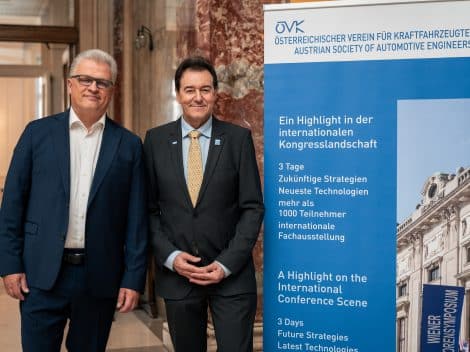
The President of the Austrian Society of Automotive Engineers (ÖVK), Professor Dr. Bernhard Geringer, today called for a neutral and comprehensive debate on propulsion technologies — one that takes into account energy availability and total greenhouse gas emissions – not just the drive system alone. The call came at the opening of the 47th International Vienna Motor Symposium at the Vienna Hofburg. At this event – the most prestigious of its kind in Europe – around 100 speakers and 1,000 guests from more than 20 major ‘automotive nations’ – such as China, Germany, France, India, Italy, Japan, Korea and the USA – will discuss the latest developments in propulsion technologies across the spectrum of vehicle types, from cars and commercial vehicles to trains, ships and aircraft: “This year, for the first time, nearly 50 percent of the presentations are coming from manufacturers— OEMs,” says Geringer, who is equally pleased with the “widest range of topics to date” ever seen in submissions for presentations.
The day before the Symposium’s official opening, a separate specialist event organized by the
ÖVK in cooperation with the Chinese branch of the Society of Automotive Engineers (SAE), China
SAE, took place in Vienna under the title ‘Forum on Powertrain for Sustainable Mobility’.
China: Largest car market with “Roadmap 3.0”
Ruiping Wang, Senior Vice President of Geely Auto, traveled all the way from China. She
provided insights into the Chinese market: “As the world’s largest automotive market, China’s
automotive industry is at the forefront of large-scale electrification development. Whilst the
rapid introduction of new energy vehicles continues, the sector is accelerating its transition
towards AI-driven intelligence, supported by digitalization.”
The executive added: “China’s ‘Roadmap 3.0 for Energy-Saving and New Motor Vehicle
Technologies’, published last year, defines the country’s future technological pathways in the
field of new energy. The report examines the future directions of automotive technology in key
areas such as highly efficient powertrains, batteries, electric motors, electronic control systems
and artificial intelligence applications. ”
Pischinger: Not a binary decision
Prof. Stefan Pischinger, Head of the Chair of Thermodynamics of Mobile Energy Conversion
Systems at RWTH Aachen University and Chair of the Supervisory Board at FEV, struck a similar
note: “The debate on propulsion technologies is still too often framed as an ‘either-or’ choice.
However, the reality of the global transformation is not a binary decision, but a complex interplay
of regulation, market requirements, technological maturity and the speed of industrial
implementation.” The implication for the industry is therefore clear: “We should not be talking
about ‘the’ powertrain of the future, but about a robust, resilient technology portfolio.”
A culture of humility
Donghee Han, Executive Vice President of Hyundai Motor Company, travelled to Vienna from
the Republic of Korea. He explained: “Hyundai’s journey in the field of powertrain technology is
characterized not only by technological milestones, but also by a culture of humility. We are
guided by the realization that we grow strongest when we learn from the world around us. Our
founder’s challenge – ‘Have you even tried?’ – continues to inspire us in our pursuit of next-
generation electric drive and range-extender technologies, as we shape a future-proof vision for
mobility.”
Modular, scalable architecture
Niklas Klingenberg, member of the Executive Board of the TRATON Group – which comprises
the four brands Scania, MAN, International Auto and Volkswagen Truck & Bus – spoke about the
“future of the powertrain” in commercial vehicles: “The TRATON Modular System is being
developed for the four brands of the TRATON GROUP under the TRATON Group R&D umbrella
with 12,000 employees. It combines battery-electric, conventional, and alternative powertrains
in a modular, scalable architecture, thereby leveraging technological synergies and
consolidating development activities efficiently. At the same time, the system’s modularity
means it can be adapted flexibly to respond to geopolitical and technological changes.”